

5 days ago
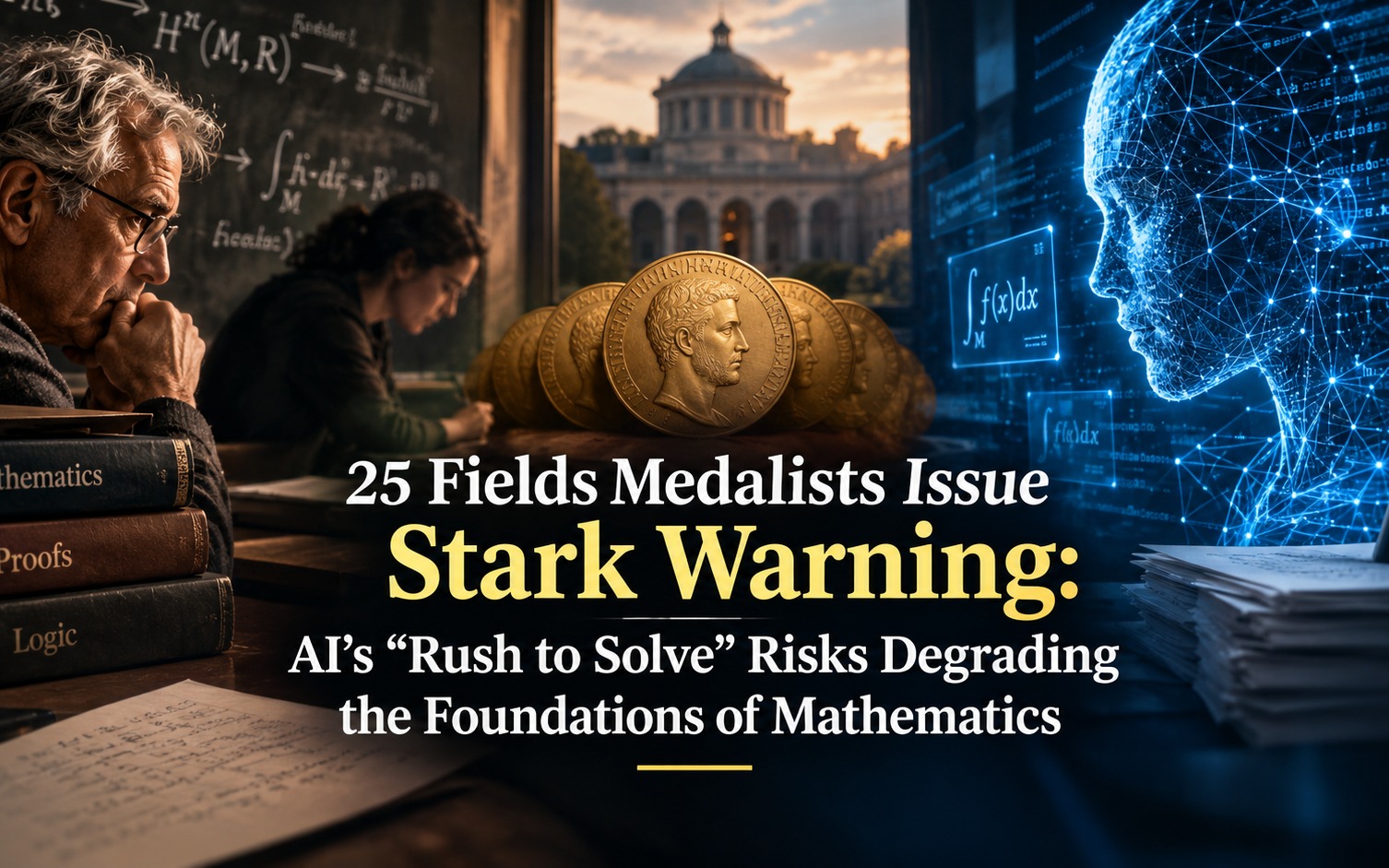
25 Fields Medalists Issue Stark Warning: AI’s “Rush to Solve” Risks Degrading the Foundations of Mathematics
A coalition of 25 Fields Medalists has published a letter cautioning against the tech industry’s current rush to solve hard mathematical problems through ai.
A coalition of 25 Fields Medalists—the recipients of the most prestigious award in mathematics, widely regarded as the discipline’s Nobel Prize—has published an open letter cautioning against the tech industry’s current rush to solve hard mathematical problems through artificial intelligence. These leading mathematicians warn that prioritizing rapid, machine-generated proofs without deep comprehension could fundamentally compromise the integrity, rigor, and pedagogical foundation of mathematics.
Beyond the “Correct Answer”: The Value of the Human Process
The signatories emphasize that the primary objective of mathematical research has never been merely discovering a “correct answer.” The enduring value of the discipline resides in the profoundly human process of “proving”: sustained scholarly debates, interrogating axioms, simplifying arguments, and integrating novel breakthroughs into the broader continuum of human thought. This transformative endeavor often spans decades. The letter cautions that modern AI strategies attempt to bypass this indispensable human work, substituting deep understanding with instant, opaque outcomes.
Three Critical Areas of Concern:
- The Comprehension and Pedagogical Crisis: While AI models can output solutions, they routinely fail to offer structured, intelligible pedagogical explanations. Scientific communities require deep, communicative understanding in order to translate new discoveries into standard academic curricula; this essential educational cycle is broken when solutions are detached from human explanation.
- The Crisis of Scientific Attribution: Modern frontier models derive their analytical capabilities from decades of uncredited human literature. Consequently, tracing the provenance of novel concepts has become exceptionally convoluted, destabilizing traditional standards of scientific attribution and intellectual property.
- A Threat to Open Science and Collaboration: The hyper-commercialization of AI has cast a chilling effect over the mathematical community. Academics are increasingly hesitant to upload preprints or share emerging hypotheses on public repositories, fearing their work will be systematically harvested as proprietary training data without consent or proper recognition. This threatens the long-standing open-collaboration ethos of the mathematical sciences.
Tangible Repercussions: Caltech Sponsorship Withdrawal and the Leiden Declaration
This tension has already precipitated tangible institutional fallout. Following widespread pushback from mathematicians regarding ethical and methodological boundaries, OpenAI recently withdrew its financial sponsorship from a premier mathematics conference held at Caltech. Concurrently, academic leaders have rallied around the “Leiden Declaration,” demanding comprehensive institutional safeguards, ethical governance, and a re-evaluation of how automated theorem-proving tools are vetted by scholarly bodies.
The medalists explicitly state that they do not oppose computational innovation, acknowledging AI’s utility as a complementary tool. However, they caution that when the mere extraction of a solution becomes the singular benchmark of achievement, society risks eroding the human enterprise that translates raw calculations into enduring wisdom—a development that serves as an urgent case study for every intellectual discipline confronting automated cognition.
Similar news




Comments
0 Comment
Most visited news

Latest articles
Contact us

All rights are reserved for the Center of Contemporary Jurisprudence, Islamic Seminary - Iran - Copyright
۰ Comment