

26 Dec 2023
Healthy Society in Digital Age: Critical Insights
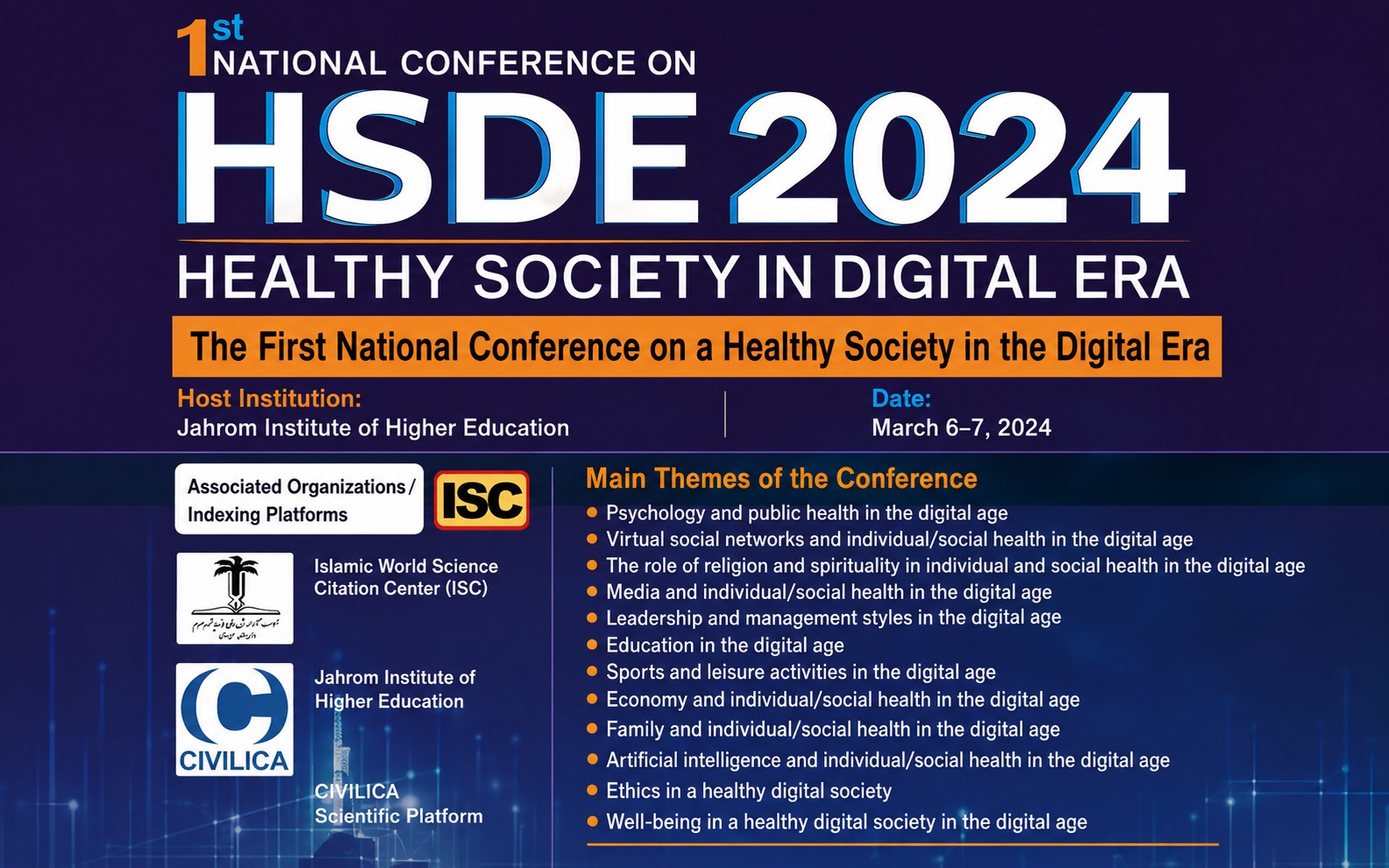
First National Conference on a Healthy Society in the Digital Age: An Interpretive and Critical Approach to be held in Iran.
The First National Conference on Healthy Society in the Digital Age: An Interpretive and Critical Approach will be held on March 6–7, 2024, hosted by the Jahrom Institute of Higher Education in the city of Jahrom, Iran.
A “healthy society” and the quality of life within it remain highly abstract concepts, lacking a single comprehensive definition. In recent years, quality of life has gained prominence in the discourse of sustainable development, social planning, and modern economic thought. Governments at both national and local levels, along with various institutions, are actively engaged in measuring and developing indicators for it.
Quality of life is inherently multidimensional and requires interdisciplinary and transdisciplinary approaches for proper analysis. As a global discourse, it has emerged as a natural response to the adverse consequences and serious harms caused by prevailing economic, cultural, and social policies at individual, national, and global levels.
In the digital age, quality of life—serving as an indicator of a healthy or unhealthy society—can function as a feedback mechanism for evaluating and recalibrating both micro- and macro-level policies. However, the digital revolution, like other technological transformations such as the genetic revolution, brings with it serious concerns and potential threats. These include the spread of globalized risks such as cybercrime, terrorism, environmental damage, and insecurity. It also poses significant challenges to personal privacy, while equipping authoritarian governments with powerful tools of surveillance and control.
Moreover, it offers unprecedented capabilities to malicious actors, including criminals and extremists, enabling manipulation, deception, and even “brainwashing.” When combined with advances in fields such as genetics, nanotechnology, and materials science, the digital revolution is pushing humanity toward profound transformations—affecting not only material conditions but potentially the very nature of human existence in ways that remain largely unknown.
Under such circumstances, ensuring quality of life becomes increasingly complex. Relying solely on past frameworks to regulate present realities would be a serious miscalculation. In Iran, these issues cannot be overlooked. The digital revolution has propelled societies into future-oriented realities, often detached from present conditions. Thus, addressing a healthy society and quality of life requires simultaneous attention to both present needs and an uncertain future.
In today’s turbulent environment, Iran can only capitalize on opportunities and mitigate threats if it creates more suitable living conditions aligned with the demands of the digital age. Importantly, defining these conditions must be grounded in lived realities—not in abstract or misguided assumptions held by policymakers. Citizens themselves must articulate what constitutes a desirable quality of life, and participatory approaches should guide its realization.
Historically, public needs have often been defined through a paternalistic framework—frequently driven more by power considerations than genuine public welfare. Given the emerging global paradigm, it is both timely and necessary to rethink this approach.
Research and academic inquiry—cornerstones of national progress—must play a central role in addressing these challenges. Today’s students, as tomorrow’s scholars, are key contributors in this process. Conferences and academic gatherings provide valuable platforms for sharing knowledge, exchanging ideas, and fostering innovation. They enable researchers to build upon each other’s findings and generate new insights within their respective fields.
It is hoped that this conference will contribute, even in a modest way, to encouraging research engagement and facilitating greater familiarity with emerging ideas and scholarly work.
Conference Themes
- Psychology and Public Health in the Digital Age
- Virtual Social Networks and Socio-Individual Well-being
- Religion and Spirituality in Individual and Social Health
- Media and Socio-Individual Health
- Management and Leadership Styles in the Digital Age
- Education in the Digital Era
- Sports and Leisure in the Digital Age
- Economy and Socio-Individual Health
- Family and Socio-Individual Health
- Artificial Intelligence and Socio-Individual Health
- Creativity in a Healthy Digital Society
- Public Health in a Healthy Digital Society
Important Dates
- Conference Dates: March 6–7, 2024
- Abstract Submission Deadline: December 21, 2023
- Full Paper Submission Deadline: January 21, 2024
- Registration Deadline: February 19, 2024
Comments
0 Comment
Most visited news

Latest articles
Contact us

All rights are reserved for the Center of Contemporary Jurisprudence, Islamic Seminary - Iran - Copyright
۰ Comment