

15 Dec 2023
‘Living AI’ Created Using Human Stem Cells
Researchers have grown an artificial brain system capable of speech recognition and solving mathematical equations.
Researchers have developed a form of “living artificial intelligence” by using human stem cells to grow an artificial brain system capable of speech recognition and solving mathematical equations. This emerging technology could mark a major breakthrough in artificial intelligence, though it also raises significant ethical and safety concerns.
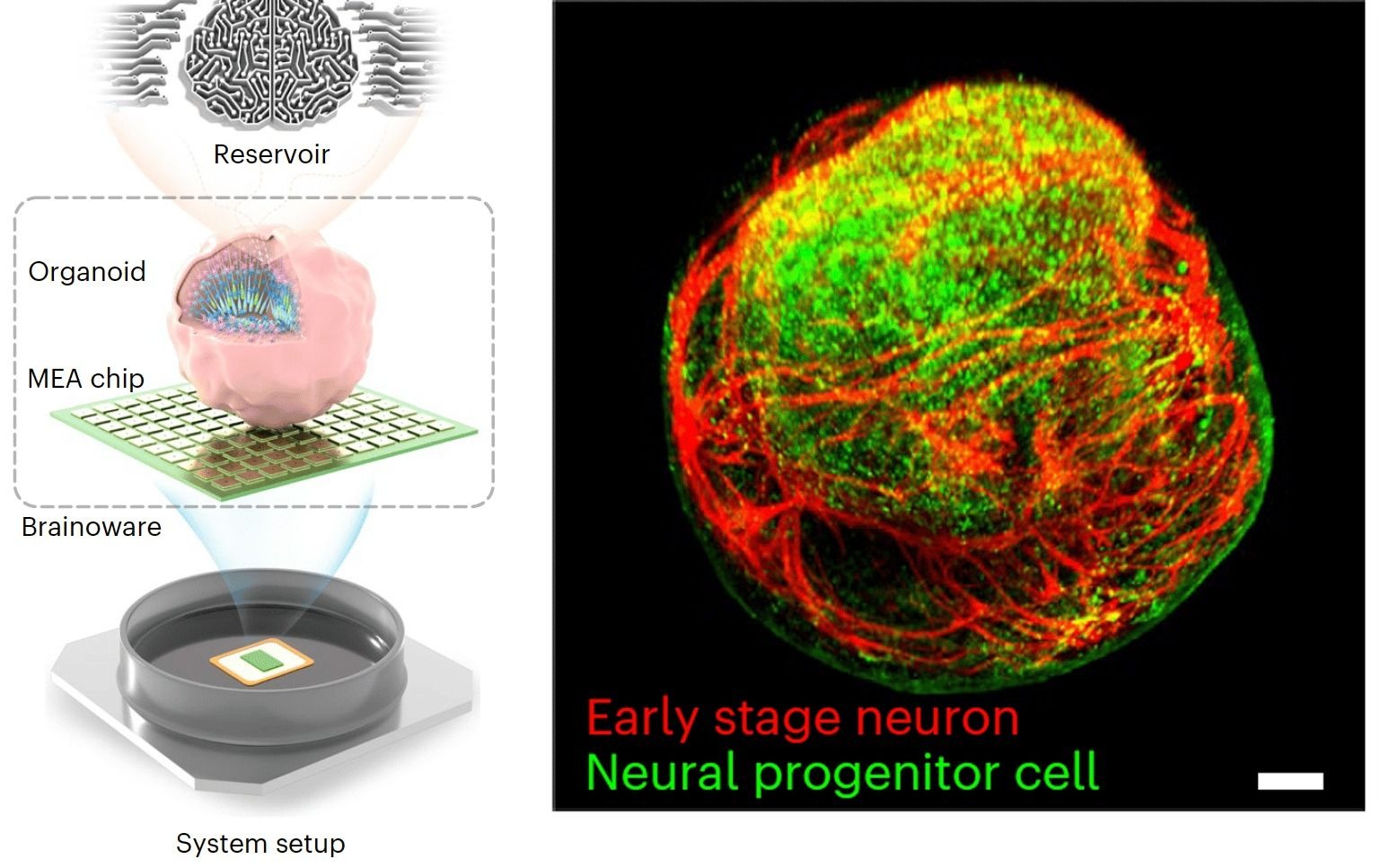
In this study, scientists extracted human embryonic stem cells—primitive cells capable of developing into specialized cell types—and cultivated them in laboratory conditions to form brain organoids. These organoids are three-dimensional cultures of neural cells that can develop complex neural networks.
Using a technique known as spatiotemporal electrical stimulation, researchers were able to regulate neural activity within these organoids. This enabled the system to exhibit advanced properties such as nonlinear dynamics and fading memory—both critical for processing complex information over time.
The organoids were then applied to two artificial intelligence tasks:
- Speech recognition
- Prediction of nonlinear equations
In both cases, the system outperformed conventional AI approaches.
In simpler terms, researchers transformed human stem cells into neuron-like structures and integrated them with a chip, creating a biocomputing system called “Brainoware.” This system can identify speakers based on audio input and solve mathematical problems.
The findings suggest that brain organoids could serve as a new platform for AI development, offering substantial potential for future advancements. However, the technology remains in its early stages and is far from widespread practical application.
Key concerns include:
- Risk of conscious AI: Some experts warn that such systems could evolve toward forms of self-awareness, raising serious ethical questions.
- Military applications: The technology could potentially be used in the development of advanced weapons or defense systems.
Key Terms Explained
- Human Embryonic Stem Cells: Early-stage cells capable of differentiating into various specialized cells, including neurons. Their use is ethically sensitive and often restricted.
- Brain Organoids: Lab-grown, three-dimensional neural cell cultures that mimic certain structural and functional aspects of the human brain.
- Spatiotemporal Electrical Stimulation: A method of controlling neural activity using patterned electrical signals across time and space.
- Nonlinear Dynamics: Complex system behaviors that cannot be described by linear equations, often involving patterns such as oscillation or chaos.
- Fading Memory: The ability of a system to retain information temporarily—essential for tasks like speech recognition.
- “Living AI”: A form of artificial intelligence built using living biological cells, such as stem cells. Compared to traditional AI, it may offer:
- Higher efficiency
- Greater adaptability
- Improved capacity to learn from complex data
For further details, readers are encouraged to consult the original study via the provided link.



Comments
0 Comment
Most visited news


Latest articles
Contact us

All rights are reserved for the Center of Contemporary Jurisprudence, Islamic Seminary - Iran - Copyright
۰ Comment