

21 Feb 2024
AI Model Trained to Think Like Leading Physicists
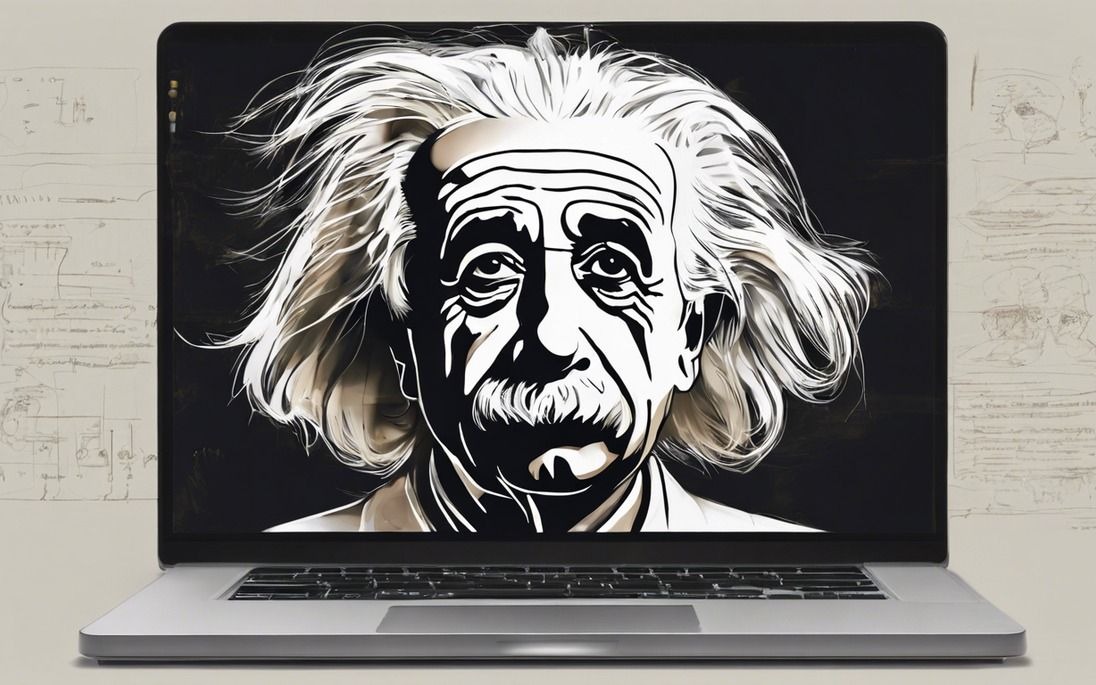
German scientists have developed an artificial intelligence model trained to reason in ways similar to renowned physicists such as Albert Einstein.
Researchers at the Jülich Research Centre successfully trained an AI system capable of identifying patterns in complex datasets and formulating corresponding physical theories. Historically, figures like Albert Einstein and Isaac Newton transformed our understanding of the natural world through groundbreaking theories. For instance, Newton’s laws of gravity not only explain gravitational forces on Earth but also enable precise predictions of the motion of planets, the Moon, and other celestial bodies.
There are two principal approaches to forming new scientific theories: deriving hypotheses from established laws, or proposing entirely new frameworks to explain observed phenomena. A key challenge lies in selecting the appropriate path. Before attempting to train AI to think like a physicist, researchers had used physical principles to better understand how AI systems themselves operate. Claudia Merger employed a neural network to model complex behavior within a simplified system. The AI achieved this by reducing intricate interactions among system components into more manageable representations.
The research team then used this simplified system to construct an inverse mapping, allowing the trained AI to move from simple components back to complex ones—ultimately generating a new theoretical framework. This process mirrors the reasoning strategies used by human physicists, with the added advantage that interactions within the AI system remain interpretable. Researchers refer to this approach as an “AI physicist.”
Merger further demonstrated how smaller structures in handwritten numbers emerge from interactions between pixels, illustrating how the AI “thinks.” The system suggested that clusters of brighter pixels play a key role in forming numerical shapes.
AI’s strength lies in its ability to analyze vast numbers of interactions simultaneously—something impractical without computational assistance. While this significantly enhances analytical capacity, traditional methods without AI are limited to much smaller systems.
What distinguishes this model from earlier AI systems is both its training methodology and its interpretability. Typically, AI models learn from data in ways that remain hidden within internal parameters. In contrast, this system allows researchers to extract both the learned theory and the “language” used to describe interactions between components.
Moritz Helias, a senior researcher, stated that the system could serve as a bridge between complex AI processes and theories that humans can meaningfully understand.
The findings of this study have been published in Physical Review X.
Comments
0 Comment
Most visited news


Latest articles
Contact us

All rights are reserved for the Center of Contemporary Jurisprudence, Islamic Seminary - Iran - Copyright
۰ Comment