

08 May 2026
Reflections on the Noor Islamic Computer Research Center
Concerns Over Western Misuse of Artificial Intelligence / How the Martyred Leader’s Support Paved the Way for Digital Transformation in Islamic Sciences
The Supreme Leader’s foresight in 1989 regarding the necessity of using modern technologies for the development of Islamic sciences has gained new significance today, as artificial intelligence increasingly shapes global scientific transformation. A path that began with the establishment of the Noor Center is now being pursued as a major national strategy focused on indigenous knowledge production, scientific authority, and positioning among the leading countries in AI for the future of Islamic sciences and national progress.
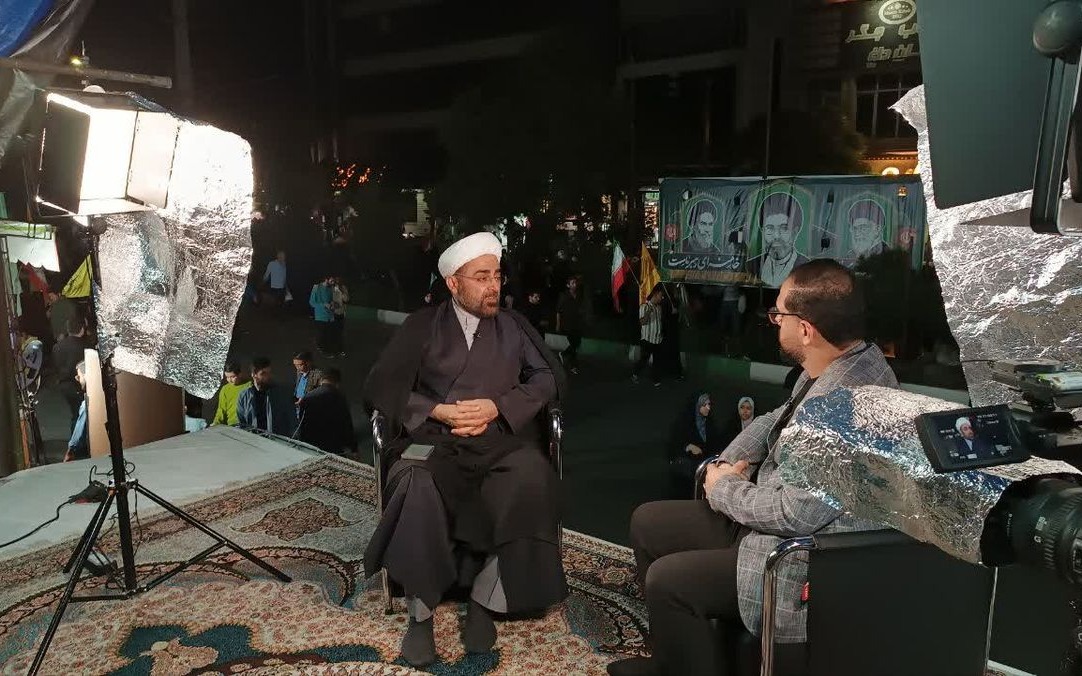
According to ILNA news agency, Hojjatoleslam Mohammad Hossein Bahrami, head of the Noor Islamic Computer Research Center, speaking at the “Ummat Mab‘uth” media pavilion in Qom, said:
“The divine awakening and the presence of the people in the field were exactly what the Supreme Leader had predicted earlier, and the people acted correctly based on the teachings they had received from the leadership. What occurred appears to have been something rare and extraordinary — a nation rising up and remaining continuously active for more than sixty days.”
He added:
“In my view, this event is unique and can only be attributed to the divine upbringing, foresight, and accurate predictions of the Supreme Leader. Up to this point, victory has belonged to our people — a victory resulting from the insight and foresight of our martyred Imam. We hope that Almighty God grants our people even greater victories under the leadership of Ayatollah Seyyed Mojtaba Khamenei”.
The Blessing of Leadership and the Foundation of Islamic Civilization
The head of the Noor Center stated:
“Throughout the Revolution, especially during the leadership of our martyred leader, God granted our people a tremendous blessing: a wise leader who, with profound foresight and penetrating vision, laid the foundations of an Islamic civilization.”
He emphasized that the late leader’s view of religion was not limited merely to ritual worship:
“He was both a religious and political leader, viewing religion as the path to humanity’s salvation in this world and the hereafter. The roadmap he designed for the country was based on this profound vision.”
A Memory About the Establishment of the Noor Center
Bahrami then shared a story illustrating the late leader’s technological vision and future-oriented thinking:
“In 1989, the first year of the Leader’s leadership, a group of seminary students and university students attempted to use computers — which at the time were scarce and very primitive in public perception — for work related to hadith and rijal studies.”
He continued:
“They presented the initial results of their work to the Supreme Leader. In the very first meeting, he instructed them to prepare a plan for establishing a center and continuing this path. A few weeks later, when they presented their proposal, he said this work was extremely important — meaning the use of computers in the development of Islamic sciences — and emphasized that every day of delay in this path would cause damage and loss.
Foresight in the Use of Technology
Bahrami noted:
“Today, in the year 1405 (Iranian calendar), such a statement may not seem surprising. But in 1989, even many prominent thinkers and intellectuals lacked the foresight to understand how deeply this technology would influence human life, scientific development, and especially Islamic sciences.”
He explained that more than three decades of work at the Noor Center have continued under the Leader’s support:
“This center is one of the legacies left for us by the martyred leader.”
He also emphasized that the center was founded directly under the Leader’s supervision, and in its early years, the Leader himself served as chairman of the board of trustees — demonstrating his deep concern for this field.
Scientific Movement and Knowledge as Power
Bahrami referred to the saying of Imam Ali (AS), “Knowledge is power”, and said:
“The Leader believed that if we seek power, dignity, independence, and a bright future, we must seriously pursue knowledge, because knowledge is the instrument of power in today’s world.”
Scientific Acceleration and Overcoming Historical Backwardness
He added:
“Another major emphasis was the scientific movement and knowledge production. During the era of dictatorship, our country fell nearly one hundred years behind in science while the world advanced and we merely became consumers of others’ achievements.”
He said Iran later experienced periods where scientific growth increased dramatically, at times becoming one of the fastest in the world, thanks to the Leader’s guidance.
Indigenous Knowledge Production
Bahrami stressed that the late leader opposed being merely consumers of foreign science:
“We should not simply repeat discoveries made elsewhere with delay and teach them to our students. We must produce indigenous knowledge ourselves.”
He cited examples such as:
• nuclear science,
• nanotechnology,
• stem cells,
• missile industries,
• and other scientific fields where Iran became a producer rather than just a consumer.
Useful Knowledge That Serves Society
He also emphasized the Leader’s focus on beneficial knowledge:
“Sometimes scientific institutions pursue metrics that do not truly benefit society. We can become trapped in article-writing or title-seeking while failing to solve the real needs of our people.”
The Leader, he said, consistently insisted that science must have practical benefit for society.
Iran as a Global Scientific Authority
Bahrami said another key objective was achieving global scientific authority:
“The Leader wanted Iran to become a reference point for science and technology — to the extent that anyone seeking the frontiers of knowledge would need to come to Iran and even learn Persian.”
He described this not as an unreachable dream, but as a realistic and achievable goal.
Artificial Intelligence as a Strategic Axis
Bahrami explained that alongside science in general, the Leader placed special emphasis on artificial intelligence as a strategic priority:
“Digital technologies, especially AI, are now among the most important drivers of scientific growth and global transformation.”
He warned that delays in AI development could repeat the historical scientific backwardness experienced during industrialization.
Concern Over Western Misuse of AI
Bahrami stated:
“Western civilization used the scientific advances it gained during previous eras to exploit many Islamic and oppressed nations. There is concern that the same pattern could be repeated with artificial intelligence.”
He added:
“Although the West outwardly emphasizes ethics in AI development, we should not be deceived by appearances. It is possible this knowledge will once again be used in the service of colonial ambitions.”
AI in Modern Warfare
Referring to recent wars, he said:
“The wars in Gaza, the Twelve-Day War, and the Ramadan War — and the use of AI in killing people — demonstrated that the Leader’s predictions were correct, and that the West has used AI to advance its ambitions.”
Future Vision and AI in Islamic Sciences
Bahrami expressed hope that AI would be used properly across all sectors:
“As the martyred leader emphasized, by deeply understanding the layers of this technology, we should become one of the top ten AI-developing countries in the world.”
He also noted that in Islamic sciences, progress has already begun:
“Today at the Noor Islamic Computer Research Center, multiple AI-based tools, systems, and chatbots have been developed for hadith studies and Islamic resources.”
He concluded by expressing hope that this movement would continue strongly and consistently under the leadership of Ayatollah Seyyed Mojtaba Khamenei enabling the country to reach the peaks of progress and raise the banner of Islamic and Iranian dignity across the world.
Similar news
Comments
0 Comment
Most visited news



Latest articles
Contact us

All rights are reserved for the Center of Contemporary Jurisprudence, Islamic Seminary - Iran - Copyright
۰ Comment