

27 Feb 2026
Iran Unveils AI-Powered Islamic Research Platforms, Marking a New Phase in Digital Islamic Scholarship
Islamic Institute of Science, Civilization, and Mysticism unveiled three new knowledge-based products designed to transform research in Islamic sciences
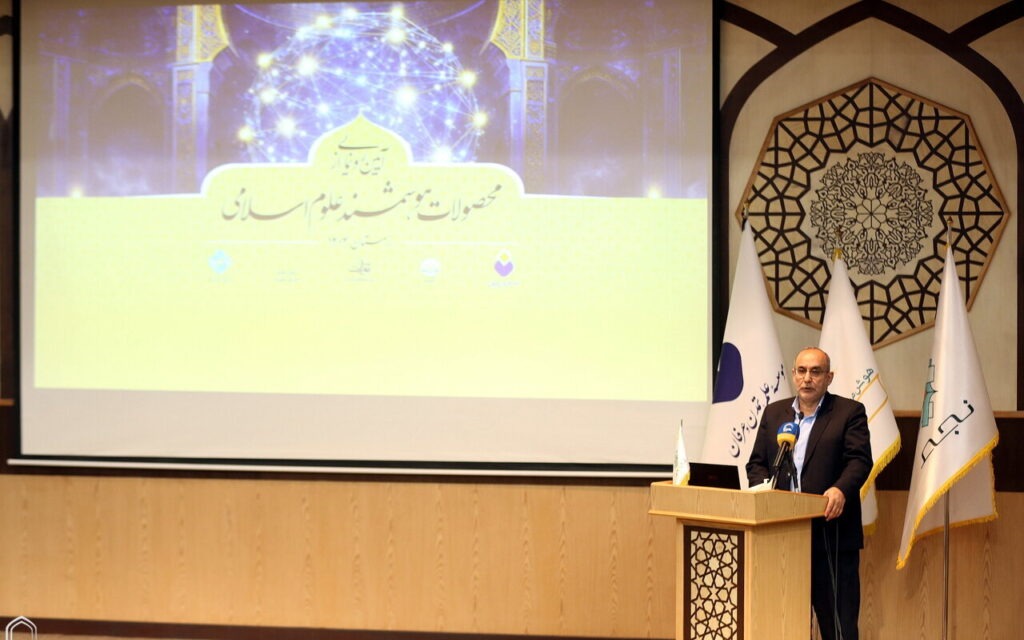
Qom, Iran – In a significant step toward integrating artificial intelligence with Islamic scholarship, the Islamic Institute of Science, Civilization, and Mysticism unveiled three new knowledge-based products designed to transform research in Islamic sciences through advanced AI technologies.
The ceremony, held at the Ahl al-Bayt Conference Hall in Qom, was attended by senior clerics, seminary scholars, and university academics, including:
Mohammad Ali Arafi, head of Iran's seminaries; Abolfazl Mobasheri Boushehri; and leading figures from Iran's religious and academic communities.
The event highlighted Iran's growing efforts to position itself at the forefront of AI-driven Islamic studies and digital religious scholarship.
Speaking at the ceremony, Dr. Behrouz Minayi, a prominent Iranian AI researcher, emphasized that the institute's mission extends beyond the digitization of religious texts.
According to Minayi, the institute—under the leadership of Ayatollah Arafi—approaches Islamic heritage from a civilizational perspective, seeking to reinterpret and present it to global audiences through advanced technological tools.
He stressed that artificial intelligence should serve as an intelligent assistant to scholars, enhancing their ability to understand and analyze complex religious, legal, ethical, and social issues.
"For the advancement of a New Islamic Civilization, we must harness the synergy between traditional scholarship and cutting-edge technology."
This framing reflects a broader Iranian discourse that sees AI not merely as a technological tool but as an instrument for advancing a modern Islamic intellectual and civilizational project.
At the heart of the initiative is the "Mujtahid Assistant", an AI-based decision-support system designed to help Islamic jurists and researchers navigate the vast and expanding body of Islamic legal sources.
The platform is intended to:
- Process enormous volumes of religious data;
- Identify hidden patterns and relationships;
- Assist scholars in drawing jurisprudential inferences;
- Support timely responses to contemporary legal and ethical questions.
- Rather than replacing religious authorities, the system is designed to augment the capabilities of scholars by accelerating research and improving access to relevant sources.
Minayi described the associated Nojum platform as:
"More than a digital library; it is a semantic processing system that organizes, categorizes, and analyzes millions of religious data points."
The system aims to facilitate more informed and efficient legal decision-making while preserving the authority of human jurists.
The institute introduced three major products that form the foundation of its AI-enabled Islamic research ecosystem.
1. Rizvan Hadith Corpus
The Rizvan Hadith Corpus is a massive digital collection containing approximately 1.28 million authenticated hadiths drawn from both Shia and Sunni sources.
Key features include:
- Twelve intelligent research services;
- Advanced search and comparative analysis capabilities;
- AI-ready structured data for machine processing.
- According to the institute, the corpus has already generated significant interest:
- More than 500 requests for access;
- Over 300 complete downloads.
Minayi described the corpus as the "fuel" that powers AI-based comparative religious research.
2. Thiqaat Mobile Application
The Thiqaat mobile application is designed specifically for scholars and researchers engaged in rijal studies—the study of hadith transmitters and chains of narration.
The application provides:
- Intelligent tracing of hadith chains;
- Analytical tools for assessing narrator reliability;
- Enhanced verification capabilities for religious researchers.
- The latest version reportedly offers improved reasoning and source-analysis functions.
3. Thiqaat Verification Platform
The Thiqaat Platform serves as a sophisticated verification engine.
Its functions include:
- Cross-referencing information from the Rizvan corpus;
- Assessing the authenticity of narrations;
- Producing results tailored to the legal methodology of individual jurists.
- The system's outputs can be configured according to a scholar's preferred jurisprudential framework, enabling customized legal analysis.
Minayi concluded the event by placing these technological initiatives within a broader civilizational and geopolitical context.
He argued that artificial intelligence can become:
"A faithful assistant in building a New Islamic Civilization—one grounded in resistance, independence, and resilience."
He also referred to the global competition in AI, particularly between the United States and China, and suggested that Iran's path to scientific and intellectual leadership lies in combining technological innovation with its deep religious and scholarly traditions.
The unveiling of these platforms represents more than a technological milestone. It illustrates several broader trends:
- Digital Transformation of Islamic Scholarship: AI is increasingly being used to process, organize, and analyze centuries of Islamic literature that would otherwise require years of manual study.
- Emergence of Computational Fiqh: The initiative contributes to the development of a new field that combines:
- Islamic jurisprudence,
- Knowledge engineering,
- Semantic technologies,
- Machine learning, and
- Decision-support systems.
- Iran's Ambition in Religious AI: The project positions Iran as one of the few countries actively developing AI systems specifically tailored for Islamic jurisprudence and religious sciences.
- Human-in-the-Loop Religious AI: The institute repeatedly emphasized that AI is intended to assist, not replace, religious scholars, preserving the central role of human juristic reasoning (ijtihad).
The launch of the Rizvan Hadith Corpus, Thiqaat Mobile Application, and Thiqaat Verification Platform, together with the development of the Mujtahid Assistant, marks an important milestone in the convergence of classical Islamic scholarship and artificial intelligence.
By combining advanced computational tools with centuries of religious knowledge, Iran's seminaries are attempting to create a new model of digital Islamic scholarship—one that seeks to modernize research, improve legal reasoning, and contribute to what its proponents describe as the construction of a New Islamic Civilization.
https://cica.ismc.ir/en/news-en/75007/iran-unveils-ai-powered-tools-to-revolutionize-islamic-scholarship-and-jurisprudence/
Similar news




Comments
0 Comment
Most visited news

Latest articles
Contact us

All rights are reserved for the Center of Contemporary Jurisprudence, Islamic Seminary - Iran - Copyright
۰ Comment