

22 Jun 2026
U.S. Muslim Jurists to Examine AI and Social Media Through the Lens of Islamic Law
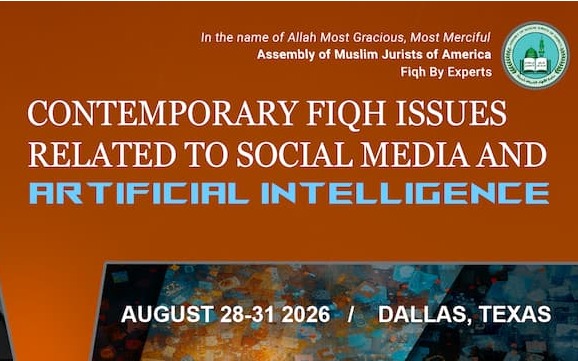
Assembly of Muslim Jurists of America has announced that its 22nd Annual Imams' Conference will focus on jurisprudential implications of social media & AI
The Assembly of Muslim Jurists of America (AMJA) has announced that its 22nd Annual Imams' Conference will focus on one of the most pressing issues facing Muslim communities today: the jurisprudential implications of social media and artificial intelligence. The conference will be held from August 28-30, 2026, followed by specialized workshops on August 31. (AMJA Online)
The conference, titled "Contemporary Fiqh Issues Related to Social Media and Artificial Intelligence," reflects the growing interest among Islamic scholars worldwide in addressing the ethical, legal, and societal questions arising from rapidly advancing digital technologies. (AMJA Online)
Among the most significant topics on the agenda is the role of AI in Islamic jurisprudence (fiqh) and religious authority.
Scholars will discuss whether artificial intelligence can:
- Answer basic and agreed-upon jurisprudential questions;
- Assist in issuing religious verdicts (fatwas);
- Perform functions traditionally reserved for qualified scholars (muftis);
- Serve as an automated commentator, hadith scholar, or mentor;
- Participate in legal arbitration and dispute resolution. (AMJA Online)
The conference will also examine whether AI can undertake forms of ijtihad—the process of independent legal reasoning—and whether machine-generated religious opinions can ever possess legitimacy without human accountability. (AMJA Online)
A separate track will explore how scholars can responsibly use artificial intelligence to improve research and education.
Topics include:
- Semantic search across classical Islamic texts;
- AI-assisted drafting of research papers and fatwas;
- Manuscript restoration using computer vision;
- Translation of the Qur'an and hadith literature;
- Generation of educational materials for seminaries and mosques. (AMJA Online)
The discussions mirror initiatives underway in countries such as Iran, Saudi Arabia, and Malaysia, where religious institutions are increasingly experimenting with AI-powered tools for Islamic research.
The conference also moves beyond scholarly applications and addresses AI's impact on everyday Muslim life.
Participants will debate issues such as:
- The permissibility of creating and sharing deepfakes;
- AI-driven surveillance and facial recognition;
- Ownership of biometric data and digital identities;
- Emotional relationships with AI companions and virtual partners;
- The use of AI for cheating, deception, and manipulation. (AMJA Online)
The agenda frames these questions through established principles of Islamic jurisprudence, including:
- Prevention of harm (la darar wa la dirar);
- Blocking the means to wrongdoing (sadd al-dhara'i);
- Protection of religion, life, intellect, family, and property—the five higher objectives of Islamic law (maqasid al-shariah). (AMJA Online)
Another major theme is the role of Muslims in building artificial intelligence itself.
Conference sessions will consider:
- Whether it is permissible to develop dual-use technologies that can be employed for both beneficial and harmful purposes;
- Ethical questions surrounding autonomous life-and-death decisions by AI systems;
- Social consequences such as unemployment and privacy violations;
- The permissibility of training AI systems on prohibited content in order to filter or moderate such material. (AMJA Online)
In recognition that AI is already transforming religious work, AMJA will also host a practical workshop titled "AI for Imams and Community Workers."
The workshop will train religious leaders to use AI tools for:
- Sermon preparation;
- Research and translation;
- Community outreach;
- Content creation;
- Detecting misinformation and developing responsible AI practices in Islamic settings. (AMJA Online)
- Another workshop will focus on engaging Generation Z Muslims, examining how social media and artificial intelligence shape faith, identity, and belonging among younger generations. (AMJA Online)
The conference underscores a broader trend in contemporary Islamic scholarship: the emergence of AI fiqh, a rapidly developing field that seeks to apply classical principles of Islamic law to questions raised by artificial intelligence and digital technologies.
By bringing together jurists, imams, and technology experts, the conference aims to provide a framework for how Muslim communities can navigate the opportunities and challenges of the AI era while remaining rooted in Islamic ethical and legal traditions. (AMJA Online)
https://www.amjaonline.org/22nd-imams-conference-fiqh-social-media-ai
Similar news




Comments
0 Comment
Most visited news

Latest articles
Contact us

All rights are reserved for the Center of Contemporary Jurisprudence, Islamic Seminary - Iran - Copyright
۰ Comment