

03 Jul 2026
Highlights of Martyred Ayatollah Khamenei's scholarly and intellectual legacy
A short review of the Martyred Supreme Leader's lifelong commitment to Islamic scholarship, education, literature, and intellectual development.
An official biography published by KHAMENEI.IR traces the life of Ayatollah Seyyed Ali Khamenei from his childhood in the holy city of Mashhad to his role as Leader of the Islamic Revolution, placing particular emphasis on his lifelong commitment to Islamic scholarship, education, literature, and intellectual development.
Born on April 19, 1939, in Mashhad, Khamenei was the second son of Sayyid Javad Khamenei, a respected but modest religious scholar who instilled in his family the values of simplicity, piety, and learning. His early education began at the age of four, when he and his elder brother attended a traditional maktab to study the Arabic alphabet and memorize the Holy Quran before continuing at an Islamic primary school.
He later entered the theological seminary in Mashhad, where, under the guidance of his father and several prominent scholars, he completed the intermediate curriculum in Islamic jurisprudence, philosophy, and logic in just five years. Reflecting on this period, Ayatollah Khamenei later remarked that his parents—particularly his father—had been the greatest influence on his decision to pursue religious studies.
Seeking advanced theological education, Grand Ayatollah Khamenei continued his studies in the holy city of Qom, where he attended the lectures of some of the leading Shiite scholars of the twentieth century, including Grand Ayatollah Hossein Borujerdi, Imam Ruhollah Khomeini, Sheikh Morteza Haeri Yazdi, Sayyid Mohammad Muhaqiq Damad, and Allamah Mohammad Hossein Tabatabai. During these years, he devoted himself to research, teaching, and scholarly inquiry.
In 1957, while still a young seminarian, Ayatollah Khamenei travelled to Najaf, Iraq, to visit the Shiite holy shrines and attend the lessons of renowned scholars such as Grand Ayatollah Mohsen al-Hakim and Ayatollah Mahmoud Shahrudi. Although he hoped to remain in Najaf, he returned to Iran the following year at his father's request and resumed his advanced studies in Qom until 1964.
His academic path changed once more when deteriorating health forced his father to return to Mashhad. Ayatollah Khamenei also returned home, caring for his father while continuing his own studies under Grand Ayatollah Milani and other scholars. Having attained the rank of mujtahid, he began teaching advanced Islamic sciences to seminary and university students. Looking back on this period, he later said, “If there have been any successes in my life, they all go back to God's blessings favored upon me because of my dutiful caring for my parents.”
Alongside his teaching, Ayatollah Khamenei developed an extensive body of scholarly work. His published writings include ( https://en.khamenei.ir/news/131432 6/31 1.)
Works Authored
- On the Four Principal Books of “Ilm ul-Rijal”
- Islamic Thought in the Quran
- Imam Al-Sadiq (a.s.)
- The Profundity of Prayer
- A Discourse on Patience
- The Spirit of Tawhid and the Denial of Worshipping Other than God
- A Report on the History and Current State of Qom Islamic Seminary
Translations (from Arabic into Farsi)
- “The Future in Islamic Lands” by Sayyed Qutb
- “Peace Treaty of Imam Hassan (a.s.), the Most Glorious Heroic Flexibility in History” by Raaz i Aal-Yasseen
- Tafsir “In the Shade of the Quran” by Sayyed Qutb
- “Muslims in the Liberation Movement of India” by Abdulmunaim Nassri
- “An Indictment Against the Western Civilization” by Sayyed Qutb
Many of his speeches, lectures, and interviews have also been compiled into books, most notably the multi-volume collection Hadith of Wilayat, while numerous academic studies have examined his philosophical and political thought.
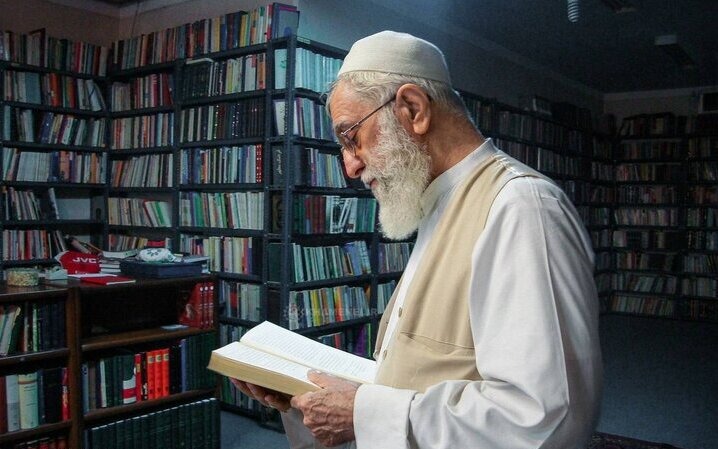
A lifelong passion for books
The Martyred Supreme Leader, was deeply engaged with Persian poetry, world literature, novels, and short stories, and maintained close relationships with writers, poets, and intellectuals throughout his life.
His speeches frequently emphasized the importance of reading in both personal and national development. Through this perspective, the value and underlying significance of a historical event can be understood that the first address of the Almighty God to Prophet Muhammad (pbuh) was to “read!" And in the first verse revealed to God's honorable messenger, the word 'pen' is mentioned with admiration and praise. "Read! Your Lord is the Most Generous, who was taught by the pen.” [Quran 96: 3-4]
"It is a great loss for a nation to be unfamiliar with books," he said in 1993. "On the other hand, it is a splendid achievement for a person to be fond of books and always benefit from them by learning new things."
On another occasion, he described books as "the essence of civilizations," while urging families to make books a household necessity, saying, "We should add books to the family basket, just like bread and food."
Throughout his annual visits to the Tehran International Book Fair, the late Supreme Leader repeatedly stressed that reading was indispensable to cultural progress.
"One should pay attention to books," he said. "One of the worst forms of indolence is laziness in reading books. The country's cultural development always needs books. A book is the most enduring work of art."
Scholars reflect on his intellectual legacy
Following his death, scholars have continued to examine Grand Ayatollah Khamenei's intellectual contributions. Last month, a forum titled "The Martyred Leader and Books: The Path Already Taken, the Path Ahead" was held by Behnashr Publishing under the auspices of the Scientific and Cultural Organization of Astan Quds Razavi.
Speaking at the event, Behnashr CEO Masoud Farzaneh said: “Revisiting the martyred Leader’s cultural conduct can guide society in turbulent times”. He asserted: “Nothing can replace books in our lives, and the martyred Leader was one of the most influential figures in strengthening Iran’s bond with reading.”
Author and researcher Mohsen Momeni Sharif explained that books were not merely tools of study for the martyred Leader; rather, they were gateways to understanding history, society, and global transformations. He noted: “The martyred Leader’s engagement with historical novels allowed him to gain novel perspectives on social dynamics. His reading shaped a strategic and civilizational outlook that defined his intellectual identity.”
He further highlighted the breadth and discipline of the martyred Leader’s personal library, calling it one of the country’s richest collections of humanities sources. https://news.razavi.ir/en/news/323/books-culture-shape-martyred-leader%E2%80%99s-intellectual-legacy

On February 28, a tragic and shocking event unfolded as Ayatollah Seyyed Ali Khamenei, the Leader of the Islamic Revolution, was martyred in a coordinated attack by Israel and the United States. The strike targeted his office in central Tehran. His martyrdom has not only sent shockwaves throughout Iran but has resonated deeply across the broader Muslim world, igniting waves of grief and outrage.
Ayatollah Khamenei was not just a political leader known for his influence on regional and global affairs; he was also a figure of cultural significance. For many Iranians, his contributions extended far beyond the realm of politics. He possessed a remarkable affinity for culture, literature, and intellectual discourse, which he championed throughout his life. His speeches often reflected his passion for books and poetry, emphasizing the importance of the life of the mind in shaping society and nurturing the spirit.
In his public addresses, Ayatollah Khamenei frequently invoked the works of great poets and thinkers, illustrating how literature could serve as a powerful tool for resistance and reflection. His love for Persian poetry resonated with many, fostering a sense of national pride and cultural identity. As a scholar and thinker, he believed that engaging with ideas and art was crucial for the moral and intellectual development of the nation.
Similar news
Comments
0 Comment
Most visited news

Latest articles
Contact us

All rights are reserved for the Center of Contemporary Jurisprudence, Islamic Seminary - Iran - Copyright
۰ Comment