

11 Jun 2026
Philosophy in the Age of Artificial Intelligence: A lifeline or a Luxury?
Webinar “Philosophy in the Age of Artificial Intelligence: A lifeline or a Luxury?” held by University of Razavi Islamic Sciences
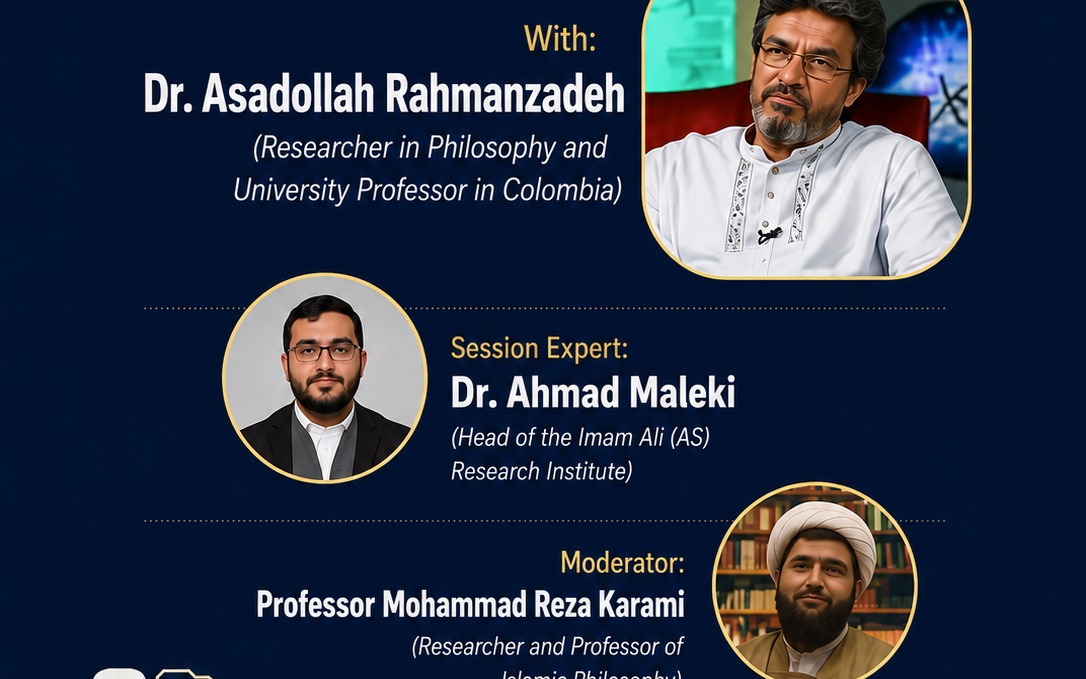
Online webinar titled “Philosophy in the Age of Artificial Intelligence: A lifeline or a Luxury?” was held by the Scientific Association of Wisdom at the University of Razavi Islamic Sciences in cooperation with Imam Ali Research Institute. The event examined the relationship between philosophy, humanity, and artificial intelligence in the contemporary world.
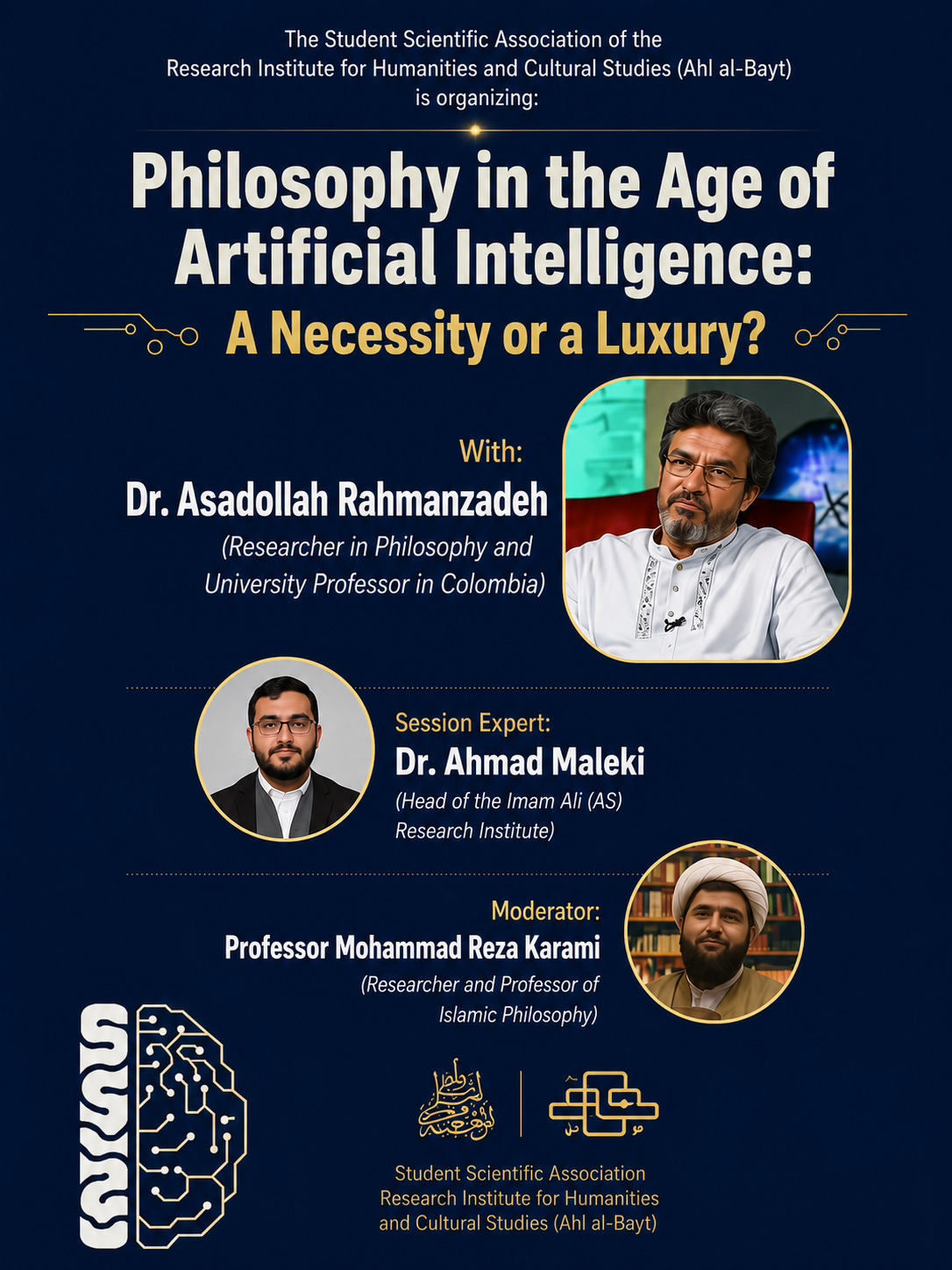
According to Astan News, the webinar was held on Monday, 8 June 2026, with Dr. Asadollah Rahmanzadeh, a philosophy researcher and professor at the University of California, as the speaker; Dr. Ahmad Maleki, head of the Imam Ali Research Institute, as an expert; and Professor Mohammadreza Karam-Rezaei as the scientific secretary.
At the beginning of the session, Dr. Asadollah Rahmanzadeh referred to the main branches of philosophy in the Western tradition, stating that philosophy in the West is generally pursued in areas such as epistemology, ontology, ethics, aesthetics, metaphysics, and logic. Overall, it concerns reflection on the limits of human knowledge, truth, existence, and the ways of human life.
He explained that philosophy begins by questioning what humans normally take for granted in everyday life, adding that people usually assume they already know what knowledge, ethics, and beauty are; however, philosophy begins precisely where these seemingly self-evident assumptions are questioned. According to him, philosophy entered a new stage with Socrates, who challenged the claims of those who considered themselves knowledgeable. Referring to the relationship between philosophy and artificial intelligence, he stated that many formal and logical structures developed in philosophy and logic are now used in AI technologies. First-order logic, probabilistic reasoning, inference, and rational planning are among the tools that play a role both in philosophical tradition and in AI modeling.
Referring to the Turing Test and the problem of distinguishing humans from machines, Rahmanzadeh added that if a machine can behave in conversation in such a way that an external evaluator cannot distinguish it from a human, it is said to have passed the Turing Test. He emphasized that today this question has become more significant: if we reduce thinking merely to logic, formal reasoning, and information processing, where does the fundamental difference between humans and machines lie?
He stressed that the crisis of the age of artificial intelligence lies in the distortion of the depth of philosophical thought and its relation to human existence. If humans are understood only in terms of instrumental rationality and formal structures, the boundary between human and machine will ultimately be weakened. According to him, in such a situation, philosophy can provide an opportunity to return to fundamental questions about human beings, meaning, truth, and human existence.
In continuation of the session, Dr. Ahmad Maleki also expressed appreciation for the activities of the Scientific Association of Wisdom at the University of Razavi Islamic Sciences and defined philosophy from his perspective, saying: philosophy is the free method of discussion centered on human understanding and reason regarding existence and phenomena. Philosophy arises when humans, without bias, preconceptions, or personal interests, seek to understand truth. He added that philosophy is not merely a set of theories or historical schools of thought; rather, its essence lies in philosophizing itself—an authentic and free intellectual movement to discover reality. According to Maleki, different philosophical schools, despite significant differences, remain within the realm of philosophy as long as they do not depart from rational and logical methods.
Referring to the relationship between religious philosophy and free thought, he stated that if someone enters philosophy with predetermined assumptions and then uses it merely to justify them, such an activity is no longer genuine philosophizing. However, this issue is not limited to religious philosophy; in many intellectual currents, philosophy may be used in service of power, desire, interests, or unexamined assumptions. Furthermore, Maleki stated that one of the features of this era is that humans compare themselves with artificial intelligence and experience an identity crisis. In this situation, the question of the difference between humans and machines becomes a fundamental issue. Emphasizing the distinction between humans and AI, he added that no matter how much data processing, analysis, and response capability AI may have, self-awareness in the true sense does not exist. In Islamic philosophy, the human soul possesses a kind of self-knowledge, and this self-awareness is considered one of the fundamental distinctions between humans and machines.
Referring to the ethical challenges of the modern world, he noted that one characteristic of the present age is the weakening of the foundations of ethics. This does not simply mean an increase in unethical behavior, but rather that in many contemporary approaches, there is no longer a rational foundation for moral obligation, making it difficult for modern humans to engage in fundamental ethical dialogue.
At the end of the session, the speakers emphasized that the age of artificial intelligence is not only a period of technological advancement but also an era that confronts humans with profound questions about truth, consciousness, ethics, meaning, and their place in the world—questions that cannot be answered without returning to philosophical thinking.
https://news.razavi.ir/fa/news/709515/فلسفه-در-عصر-هوش-مصنوعی-ساحلی-برای-نجات-انسان-یا-یک-سرگرمی-بیهوده
Similar news



Comments
0 Comment
Most visited news

Latest articles
Contact us

All rights are reserved for the Center of Contemporary Jurisprudence, Islamic Seminary - Iran - Copyright
۰ Comment