

08 Oct 2026
Islamic Research Center of Parliament Releases Strategic Report on AI Jurisprudence and Legislation
The strategic report examines the jurisprudential and legislative challenges posed by artificial intelligence (AI)
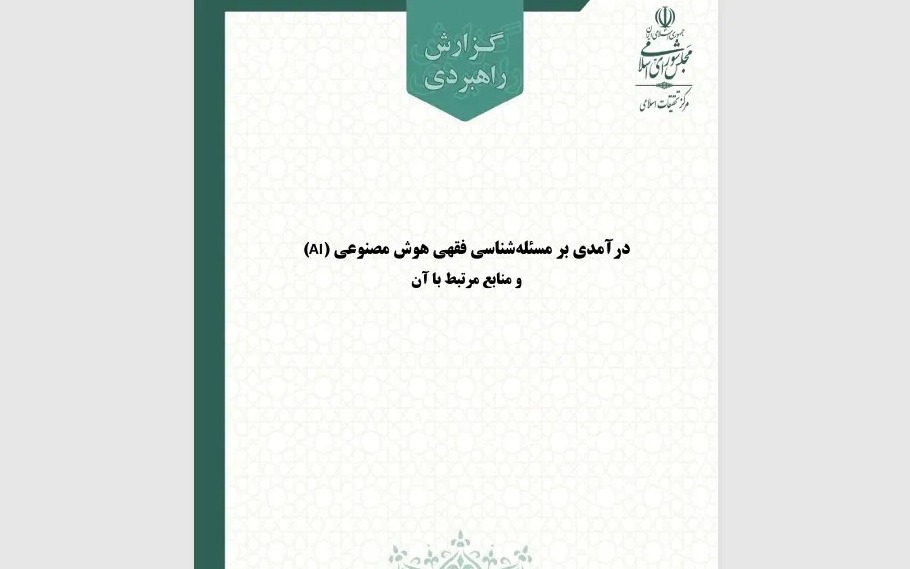
TEHRAN — The Islamic Research Center of Iran’s Parliament has published a strategic report examining the jurisprudential and legislative challenges posed by artificial intelligence (AI), with a particular focus on identifying emerging legal and religious issues and reviewing the body of research available in the field.
Titled *An Introduction to the Jurisprudential Problem Analysis of Artificial Intelligence (AI) and Related Resources*, the report was prepared by Hojjatoleslam Seyfollah Sokhaei-Far and scientifically reviewed by Hojjatoleslam Sajad Dinparasti Saleh. Rather than providing definitive religious rulings, the study seeks to formulate key questions and identify areas requiring legislative and scholarly attention.
The report argues that advances in AI have moved beyond the traditional perception of technology as a passive tool. Capabilities such as autonomous decision-making, content generation, and automated coding, it states, necessitate a reassessment of established jurisprudential concepts, including intention, legal capacity, liability, testimony, and adjudication.
In its first section, the report categorizes AI-related jurisprudential issues into five principal areas. Among the subjects examined are the possibility of machine-generated legal reasoning and fatwas, the evidentiary value of AI-generated reports in judicial proceedings, intellectual property rights associated with AI-created works, automated transactions, and the use of AI as an aid in Islamic legal reasoning (ijtihad).
The study also addresses the jurisprudence of AI-related commerce, exploring legal questions surrounding the sale and lease of AI models, access to application programming interfaces (APIs), the economic value and ownership status of data and algorithms, and the legal treatment of physically embodied robotic systems.
Liability arising from AI use forms another major area of analysis. The report examines how civil responsibility may be distributed among developers, operators, publishers, and end users in cases involving harm caused by intelligent systems. It also explores the possibility of criminal liability connected to AI-related conduct and revisits fundamental concepts such as intent and free will.
A further section focuses on governance and regulation, including religious oversight of AI technologies, state regulation and sanctions, protection of sensitive national data, the impact of automation on employment, and the jurisprudential status of lethal autonomous weapons. The report additionally discusses the legitimacy of delegating certain governmental powers to computational systems, the potential use of AI in judicial processes, and the limits of assigning senior administrative responsibilities to such systems.
The second part of the publication surveys the existing academic literature on AI and Islamic law. It reviews advanced jurisprudence courses dedicated to AI, introduces specialized books on the subject, and highlights 33 peer-reviewed scholarly articles addressing issues such as civil and criminal responsibility, judicial procedure, and the legal personality of artificial intelligence.
To advance future research and policymaking, the report proposes several initiatives, including the establishment of a National Center for Jurisprudence and Artificial Intelligence, the development of a research roadmap aligned with urgent legislative needs, the formation of a task force to draft forward-looking regulations and interim ethical frameworks, and greater investment in training specialists with expertise spanning both Islamic jurisprudence and emerging technologies.
According to the report, these measures would help distinguish between immediate, practical challenges and more speculative future concerns, while providing a framework for prioritizing research and addressing legislative gaps related to artificial intelligence.
https://rasanews.ir/fa/news/829330/گزارش-مرکز-تحقیقات-اسلامی-مجلس-درباره-مسائل-فقهی-هوش-مصنوعی-منتشر-شد
Similar news





Comments
0 Comment



Contact us

All rights are reserved for the Center of Contemporary Jurisprudence, Islamic Seminary - Iran - Copyright
۰ Comment