

26 Feb 2024
Department of Contemporary Jurisprudence (Fiqh) as a Reference Authority for Major Governance Issues
Department of Contemporary Jurisprudence serves as a reference authority for addressing major governance-related issues, and there is a need for transformation
“Qom Seminary / The Department of Contemporary Jurisprudence (Fiqh) of the Qom Seminary said: In addition to producing knowledge, the department functions as a reference authority for addressing many major governance-level issues, and we are in need of transformation in governance.”
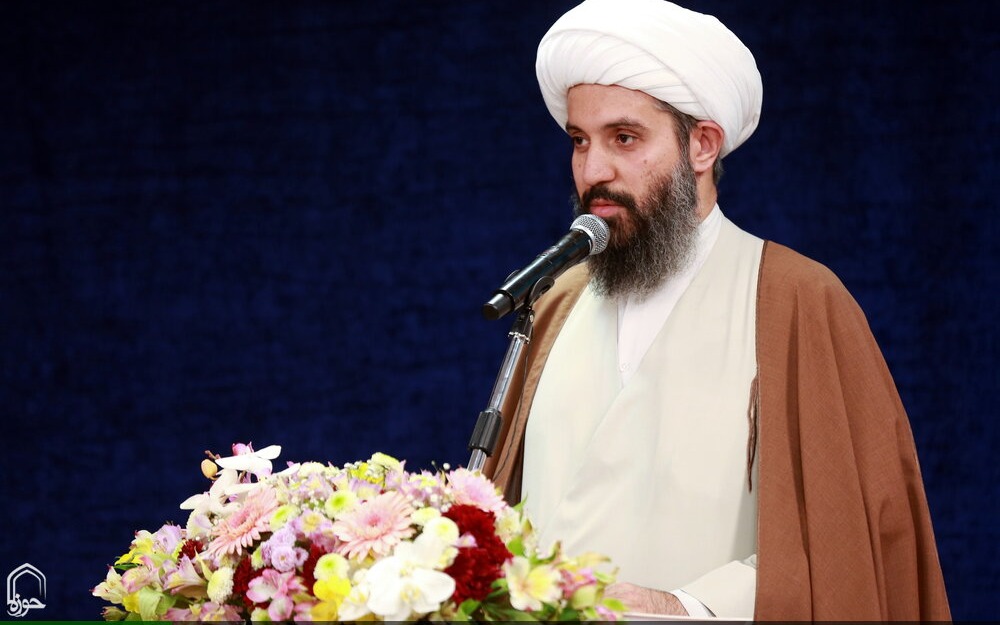
According to the Hawzah News Agency reporter, Hujjat al-Islam wal-Muslimeen Hossein Ethna Ashari, Director of the Department of Contemporary Jurisprudence (Fiqh) of the Qom Seminary, speaking at the ceremony for the unveiling works on the jurisprudence of the stock market and securities held at the meeting hall of the Seminary Management Center in Qom, stated that this office began its activities in 2016 with five main objectives.
The Director of the Department of Contemporary Jurisprudence (Fiqh) of the Qom Seminary explained that the first objective was the authorship and compilation of books for advanced levels of seminary studies, an issue that has long been emphasized by the Supreme Leader, religious authorities (maraji‘), and seminary students in recent years.
He continued that two books have so far been prepared in this regard and incorporated into the seminary curriculum. Each year, nearly 3,000 students study these books in classes, and more than 300 instructors are engaged in teaching them.
Hujjat al-Islam Ethna Ashari added that the second objective has been the expansion of advanced (kharij) courses focusing on contemporary fiqh. Since the establishment of the office, this goal has been seriously pursued, and the number of courses has expanded from only a few initial sessions to 105 courses across 23 major areas of contemporary jurisprudence.
He noted that topics such as social issues, ethics, education, medicine, cryptocurrencies, economics, and artificial intelligence are among the main subjects of these courses, and so far 180 dissertations are currently being written in the field of contemporary fiqh.
The Director of the Department of Contemporary Jurisprudence (Fiqh) of the Qom Seminary stated that the third objective is the provision of introductory courses in contemporary sciences. He explained that books published over the past century by Islamic legal scholars in contemporary subjects needed scholarly revival.
As a result, works authored by Islamic legal scholars over the past one hundred years on contemporary issues have been incorporated into the seminary curriculum as elective courses, and each year around 100 classes are offered to 1,000 students in areas such as social, political, and economic studies.
Hujjat al-Islam Ethna Ashari stated that the fourth objective of the office is writing academic articles in contemporary fiqh in order to strengthen the connection between seminary ijtihad and the academic community. Many of these articles have been written by senior scholars using both seminary expertise and modern academic language.
He noted that efforts have consistently been made to ensure these works are also suitable for academic university circles. For example, a lecture by Ayatollah Marvi on cryptocurrencies was initially written by seminary scholars, then developed into academic papers in cooperation with university economic experts, and published in the Central Bank’s Monetary and Banking journal. He added that some of these articles have been published, and some have even been presented in international forums, including a paper on artificial intelligence and the humanities recently presented at a scientific conference in Oman.
Hujjat al-Islam Ethna Ashari further stated that the office’s goal for the coming year is to have a more active international presence and to present its jurisprudential works globally.
He added that the fifth objective is the development of legislation, internal regulations, and the critical review of international documents, such as UNESCO’s AI Ethics Recommendation. In this regard, extensive cooperation is underway between researchers of the Contemporary Fiqh Office and government institutions, parliament, the Guardian Council, and other governing bodies.
The Director of the Department of Contemporary Jurisprudence (Fiqh) of the Qom Seminary emphasized that, in addition to knowledge production, the office functions as a reference authority for addressing many major governance-related issues, and its vision includes expanding the teaching of ijtihadi courses in economic, educational, ethical, and intellectual fields, as well as influencing academic discourse.
At the end, a senior lecturer of advanced levels at the Qom Seminary concluded by stating: “Whenever the governing system has seriously and genuinely engaged in scholarly interaction with the seminary, we have witnessed high-quality, outstanding, and lasting academic outputs at the national level. One example is the country’s Constitution. The majority of the drafters of the Constitution in the first parliament were jurists and senior figures from the seminaries, and in the second parliament, all members except two were from seminary backgrounds. Therefore, we can say that the Constitution is a product of the seminaries.
To continue along this path, we must witness a fundamental transformation in governance and in its relationship with the seminary, just as we have witnessed a meaningful scholarly transformation within the seminary itself. If this transformation takes place within governing institutions, we will see outstanding outputs in the direction of Islamic civilization.”
https://www.hawzahnews.com/news/1233419/دفتر-فقه-معاصر-مرجعی-برای-پاسخگویی-به-مسائل-کلان-حاکمیتی
Similar news



Comments
0 Comment
Most visited news



Latest articles
Contact us

All rights are reserved for the Center of Contemporary Jurisprudence, Islamic Seminary - Iran - Copyright
۰ Comment