

08 Jun 2026
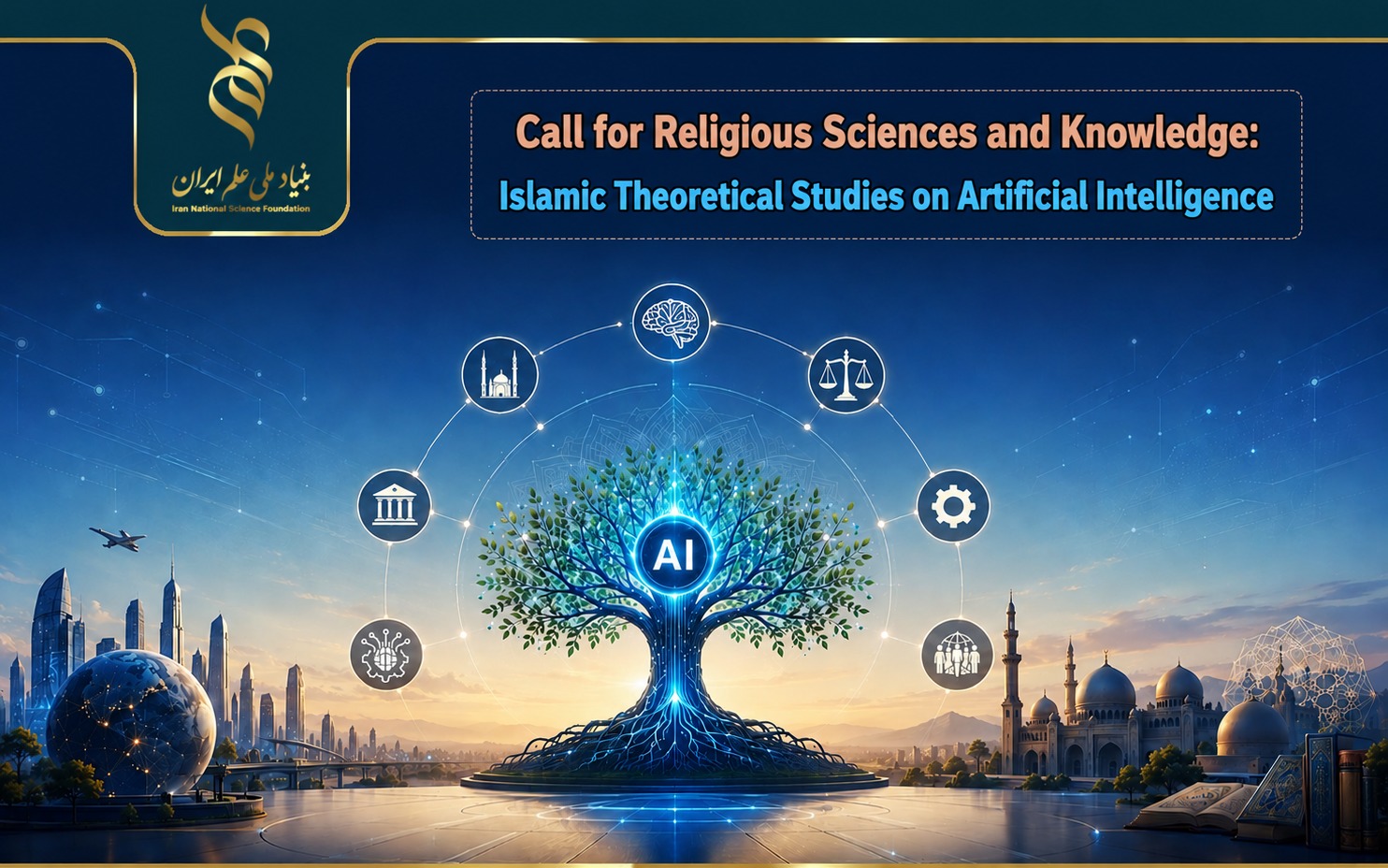
Call for Proposals For Research Grant in Religious Studies: Islamic Theoretical Studies on Artificial Intelligence
Faculty members can apply for a special research grant “Religious Sciences and Knowledge: Islamic Theoretical Studies on Artificial Intelligence”
Tehran (IRNA) – A special research grant call titled “Religious Sciences and Knowledge: Islamic Theoretical Studies on Artificial Intelligence” has been announced for faculty members. Applicants may submit research proposals from June 7 to August 7, 2026.
According to the National Science Foundation of Iran, artificial intelligence (AI) is one of the most advanced and influential technological achievements of the 21st century. Its impact extends far beyond scientific and industrial fields into nearly every aspect of human life, and this influence continues to expand rapidly. It can even be argued that AI has fundamentally changed the way people live. While AI initially appears to be a technology that serves humanity by dramatically increasing efficiency and productivity, a deeper examination reveals that it is reshaping the world and, consequently, transforming human beings themselves. This broad influence creates not only opportunities but also complex challenges that require careful and comprehensive study.
The call invites faculty members from universities, seminaries, and recognized research institutions to submit proposals in the following priority areas.
Priority Research Areas
1. Philosophical and Rational Studies of AI
- Ontology of AI
- Epistemology of AI
- Logic of AI
- Human foundations of AI (philosophy of mind and AI)
- Value foundations of AI (AI ethics, etc.)
- Psychology of AI
- Cognitive science and AI
2. Theological and Religious Studies of AI
- Theology of AI
- Islamic theology (kalam) and AI
- Islamic jurisprudence (fiqh) and AI
- Religious studies and AI
- Islamic studies and AI (Qur’anic studies, exegesis, principles of jurisprudence, Islamic history)
3. Legal and Economic Studies of AI
- AI law (foundations, applications, development)
- AI economics (foundations, applications, development)
4. Governance and Policy Studies of AI
- AI governance
- Cyberspace and AI
- Security and AI
- Cognitive warfare and AI
- Politics and AI
5. Applied AI Studies
- Strategies for using AI in religious studies and activities
- Opportunities and challenges of AI adoption
- AI in education
- AI in religious outreach and preaching
- AI in research
- AI in judicial decision-making
- AI in training and character development
6. Futures Studies of AI
- Foundations of AI foresight and future studies
- AI singularity
- AI and future studies of religion and religiosity
- Artificial life
- Smart government and smart cities
7. Civilization, Society, and Culture Studies
- Sociology of AI
- Cultural studies of AI
- Family and AI
8. AI and the Human and Islamic Sciences
- Nature and identity of digital humanities and digital Islamic studies
- Ontological, anthropological, epistemological, and theological foundations of digital humanities and Islamic sciences
- AI-related issues in literature, sociology, psychology, linguistics, management, economics, political science, education, family studies, culture and civilization, and history
Eligibility
Applicants must be active faculty members of:
- Universities,
- Islamic seminaries,
- Or research institutions approved by the Ministry of Science, Research and Technology.
Applicants should possess a relevant academic record in Islamic theoretical studies of AI. Those lacking direct expertise must collaborate with researchers knowledgeable in both AI and Islamic theoretical studies.
Required Research Outputs
Applicants must commit to delivering the following mandatory research outputs:
- One scholarly book presenting the project's theoretical framework, findings, and contributions.
- Peer-reviewed research articles, including at least one of the following:
- Articles published in ISC-indexed academic journals; and/or
- Articles published in reputable international journals indexed in recognized citation databases such as JCR, ISI (Web of Science), or Scopus.
Researchers may also propose additional outputs—such as policy briefs, educational materials, digital resources, conference presentations, or other scholarly products—where appropriate to the objectives and scope of the project. Such outputs will be evaluated based on their relevance, quality, and potential impact.
Research Requirements
To ensure focused and impactful work, proposals should be:
- Theory-building and innovative,
- Addressing specific theoretical problems in AI,
- Problem-oriented rather than overly broad,
- Grounded in a thorough review of prior research.
Timeline
- Call Opens: June 7, 2026
- Submission Deadline: August 7, 2026
Funding
The foundation will provide support of up to 1.5 times the amount of standard research grants, with a maximum funding level of approximately 375 million Iranian tomans.
Final funding decisions will depend on factors such as:
- Originality of the topic,
- Limited prior research,
- Number of collaborators,
- Diversity of outputs,
- Scope of commitments and deliverables.
Application Process
Researchers must apply through the foundation’s Kayper online system (https://rtms.insf.org/ ) . Applicants who do not already have a profile must first register and then log in using their email address and assigned password.
After logging in, applicants can select the special call “Religious Sciences and Knowledge: AI Studies” from the “Submit New Proposal” section and upload their research proposal.
Questions regarding submission procedures, eligibility, or scientific content may be submitted through the ticketing system within the applicant’s Kayper profile to the Humanities, Social Sciences, and Arts Program Working Group.
Similar news
Comments
0 Comment
Most visited news


Latest articles
Contact us

All rights are reserved for the Center of Contemporary Jurisprudence, Islamic Seminary - Iran - Copyright
۰ Comment