

11 Oct 2022
DCF’s Program to Strengthen Hawza–University Cooperation
This report addresses the challenges and selected examples of existing issues involved in building effective links between universities and the Islamic seminary
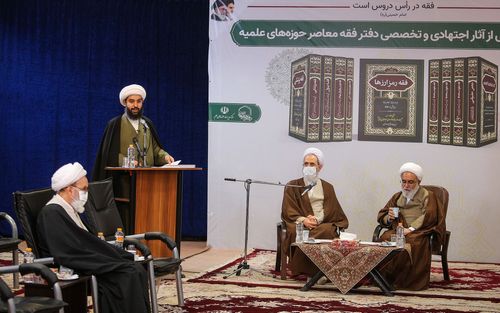
During the unveiling ceremony of the ijtihadi works of the Department of Contemporary Jurisprudence (Fiqh) in December 2021, Ayatollah Alireza A‘rafi made a strategic statement, for the first time publicly announcing a multi-year scholarly and strategic initiative undertaken by the Department of Contemporary Jurisprudence (Fiqh). This initiative—designed to untangle real and substantive academic challenges without resorting to media-driven narratives or attributing blame to others, in line with the department’s established approach—has been underway and is currently being actively implemented.
Drawing on his years of experience in leading the Hawza–University Research Institute, Jami‘at al-Mustafa al-‘Alamiyya, as well as his membership in the Supreme Council of the Cultural Revolution and the boards of trustees of several universities, Ayatollah A‘rafi stated: “The relationship between the Hawza and the university is now taking shape in a new form.”
It is evident that accurate understanding of contemporary issues today requires familiarity with the latest global scholarly outputs, as well as awareness of up-to-date questions raised by the public and by specialists—both domestically and internationally. Only through such engagement can the effectiveness and relevance of scholarly production be ensured.
Alongside other methodological approaches, universities constitute one of the institutions capable of playing a constructive role in this process. However, several serious obstacles exist in this collaboration. Some of these have already been resolved, while others are nearing resolution. This emerging model of cooperation is precisely the approach referenced by Ayatollah A‘rafi.
Below are examples of some of the existing challenges:
First: Experts and faculty members in each academic institution tend to analyze issues from perspectives that are not necessarily transferable, in the same form, to jurisprudential (fiqhi) inquiry. A clear example is the medical and clinical analysis of brain death. While such analyses are valuable for medical education, they often fail to clarify dimensions of the issue that are essential for fiqhi reasoning. At present, however, the challenge of developing a shared technical language between the two fields has been largely resolved in many areas.
Second: Despite the fact that Hawza journals, under approved regulations, hold recognized academic–research status, and notwithstanding the presence of leading Hawza institutions and scholars producing highly rigorous and precise research across various disciplines, collaboration with the Hawza or publishing in seminary journals is still not recognized as a research activity in most universities in the country and does not contribute to academic promotion. As a result, the full scholarly capacity of university faculty remains underutilized.
The root of this problem, however, is not limited to regulatory frameworks or administrative bylaws. Rather, it stems from the fact that the impact and position of rigorous Hawza sciences in advancing the frontiers of knowledge—and even in bringing about foundational and paradigm-level transformations in the sciences—have yet to be fully appreciated by many university researchers.
Through the sustained efforts of Faqihs, seminary professors, and researchers, together with a broad university network that has collaborated with the Center of Contemporary Fiqh for more than five years, this issue is now approaching resolution. With the intensive activities initiated at the beginning of 2022, there is strong hope that tangible and effective steps will be taken in this field during the current year. Naturally, an endeavor that long appeared unattainable requires sufficient time to become fully established.
We firmly believe that leading Hawza scholars are not confined solely to Qom, nor are outstanding university academics limited exclusively to Tehran. Rather, across Iran we have identified—and will continue to identify—elite scholars who will accompany us on this path.
Similar news

Comments
0 Comment
Most visited news



Latest articles
Contact us

All rights are reserved for the Center of Contemporary Jurisprudence, Islamic Seminary - Iran - Copyright
۰ Comment