

03 Apr 2022
Symposium on AI and Digital Currencies: A Sharia Perspective
UAE University College of Law Hosts Symposium on “Artificial Intelligence and Digital Currencies: A Sharia Perspective”
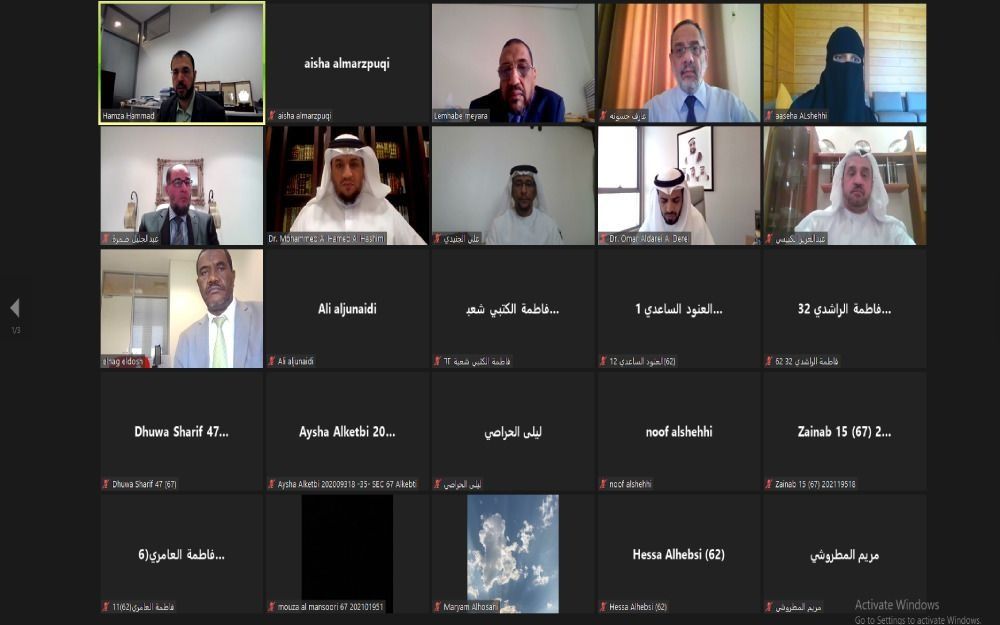
The Department of Sharia and Islamic Studies at the College of Law, United Arab Emirates University, in cooperation with the General Authority of Islamic Affairs and Endowments, held an academic symposium titled “Artificial Intelligence and Digital Currencies: A Sharia Perspective.”
Dr. Hamza Abdulkarim Hammad, Head of the Department of Sharia and Islamic Studies, explained that the symposium was organized with the aim of highlighting issues related to artificial intelligence and digital currencies from a fiqhi–legal perspective. He noted that the program covered a range of topics, including artificial intelligence—its concept, origins, and impacts—as well as the nature of digital currencies and their various types.
The symposium was held in two sessions.
The first session, titled “Artificial Intelligence: Concept, Origins, and Impact,” opened with a keynote address by Dr. Omar Al-Derai, Executive Director of Islamic Affairs at the General Authority of Endowments. In his remarks, he emphasized the importance of the UAE’s proactive adoption of artificial intelligence across various government institutions. He noted that the experience of applying AI within the Islamic Affairs sector—particularly in the Fatwa Center—has been successful. AI applications have included innovative services based on measuring user satisfaction, as well as automated response systems utilizing model-based fatwas.
Regarding the scholarly papers presented in this session, the first was delivered by Dr. Mohammed Mayara, a faculty member of the Department of Sharia, on “The Status of the Mind and Its Impact on Artificial Intelligence: A Qur’anic Perspective.” The paper examined the concept of artificial intelligence, the meanings and benefits of the intellect, the relationship between reason and revelation, and Qur’anic guidance concerning the use of the mind.
This was followed by a paper by Dr. Abdulaziz Shaker Al-Kubaisi, faculty member of the Department of Sharia and Islamic Studies, titled “The Ethics of Artificial Intelligence from an Islamic Perspective.” The paper addressed issues such as the legitimacy of design and operation, neutrality and justice, security and control, respect for privacy, system governance, environmental sustainability, and respect for individual, institutional, and intellectual property rights.
The session also included a paper by Dr. Aisha Al-Shehhi entitled “Smart Contracts and Their Provisions in Islamic Jurisprudence,” which discussed the concept of contracts in Islamic fiqh, their relationship to smart contracts, the jurisprudential compatibility of smart contracts, and their application in Islamic financial transactions.
The second session focused on “Digital Currencies: Concept, Compliance, and Risks”. In this session, Dr. Aref Hassouna, a faculty member of the Department of Sharia and Islamic Studies, presented a paper titled “The Jurisprudential Compatibility of Encrypted Virtual Currencies”. The paper reviewed differing approaches to encrypted virtual currencies in comparison with traditional currencies and identified three main views:
- Suspending judgment until further dimensions become clear;
- Adopting a differentiated, case-by-case approach; and
- Rejecting the recognition of mālīyah (recognizable economic value) for encrypted virtual currencies—a position held by most contemporary scholars and reflected in many official fatwas across the Islamic world.
Subsequently, Professor Dr. Haj Al-Doush, also from the Department of Sharia and Islamic Studies, presented a paper titled “Digital Currencies in Light of Artificial Intelligence: A Jurisprudential Perspective,” addressing the concept and characteristics of digital currencies, their structural relationship with artificial intelligence, and issues such as uncertainty (jahālah), deception, and gambling (qimār) associated with digital currencies.
Another paper, “An Analysis of Jurisprudential Disputes Concerning Encrypted Digital Currencies,” was presented by Dr. Salem Al Ali, faculty member of the Department of Sharia and Islamic Studies. He reviewed jurists’ opinions on the legality of encrypted digital currencies and analyzed the roots of the existing fiqhi disagreements on the matter.
The symposium concluded with a paper titled “The Risks of Digital Currencies and Ways to Address Them,” presented by Dr. Mohammed Al-Humaid Al-Hashemi, a faculty member of the Department of Sharia and Islamic Studies, which examined the concept of digital currencies and the challenges associated with them.
Similar news


Comments
0 Comment
Most visited news

Latest articles
Contact us

All rights are reserved for the Center of Contemporary Jurisprudence, Islamic Seminary - Iran - Copyright
۰ Comment